Coreopsis has more than 80 species to choose from and is valued for its summer-long blooms and low maintenance. Pollinators love them and so will you! This bee loves an Uptick Gold and Bronze Coreopsis prized for its colorful flowers.


Coreopsis has more than 80 species to choose from and is valued for its summer-long blooms and low maintenance. Pollinators love them and so will you! This bee loves an Uptick Gold and Bronze Coreopsis prized for its colorful flowers.
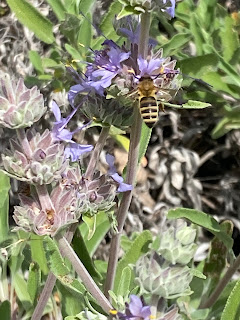
Spring has come early to my California garden and the Bee's Bliss sage is blooming, and like its name, it is creating bliss-filled days for the bees and other pollinators. It is a great plant to consider for a Western garden as it is drought tolerant once established. It can handle a wide range of garden conditions, growing around 2 feet high and 6-8 feet wide. With grey-green leaves and spike-like, lavender flowers, Bee's Bliss is a favorite of hummingbirds. Deer detest it; another good reason to add it to your garden favorites!
Yellowjackets are probably the most feared enemy of every summer picnic. While bees are minding their business collecting pollen, wily wasps, namely, yellowjackets, are in search of food and attack your plate with greedy ferocity. They have a nasty sting, along with their close cousin, the hornet, that is also highly aggressive.
Yellowjackets and hornets are social wasps. Yellowjackets live in underground nests, whereas hornets build the stereotypical hive that looks like a papery, grey football. Surprisingly, most wasps live a solitary existence and don’t sting. Like bees, wasps bring huge ecological benefits to our ecosystem. They pollinate flowers and food crops as bees do and control the populations of crop pests such as whiteflies, caterpillars and beetle grubs. Many farmers know the benefit of using wasps as natural pest control for food crops, which minimizes the need for toxic pesticides that destroy pollinators and their environment. A small colony of wasps can eat up to 3,000 mosquitos and flies per day, killing off insects that carry human diseases. They keep the environment clean, feeding on dead animals like mini-garbage disposals. While often eating their prey themselves, they also bring food back to their nests to feed their growing larvae.
Bees have started to attract a lot of public interest and support as news of their decline has made headlines. Not so for wasps, which are also threatened due to climate change, habitat loss and pesticides. Because they play an important role in the ecosystem, wasps also deserve appreciation and support, as do all the other pollinators in decline.
A Mud Dauber wasp on a Bird of Paradise flower

"I'm a carpenter bee and I dig a tunnel in wood that becomes a nest for my brood..."
Carpenter Bees
Carpenter bees get
their name because they usually excavate tunnels in wood to build their nests
in. Some carpenter bees and bumblebee queens are the largest native
bees in the United States. They don't eat the wood they carve, but they can
cause damage to structures that are dry, weathered, and in need of replacement.
Carpenter Bee Habitat
Carpenter bees are not social insects like honey or bumblebees,
which is why they don't live in hives and create individual nests in trees,
eaves, or sides of structures. They overwinter in old nest tunnels and in the
spring they emerge to mate. While the mated female chooses a suitable piece of
wood for her nest, the male spends most of his time protecting the nest site by
hovering and chasing intruders away. The female makes a tunnel using her
mandibles and then furnishes her nest with a mixture of nectar and pollen
called "bee bread." She lays an egg and then chews the wood into a pulp to plug
the nest cell with.
Carpenter Bee
Behaviors
Male carpenter bees don't have stingers but act threatening while protecting a nest. Female carpenter bees usually won't sting because they'll die and won't be able to take care of their eggs. If someone is allergic to bee venom and is stung by a carpenter bee, they should seek medical attention immediately.


Thanks to the squash bee, we have pumpkins to carve for Halloween and tasty
vegetables to eat at Thanksgiving!
The Mason Bee - A Mighty Pollinator!

When most of us hear the word “bee,” an image of a honeybee or bumblebee comes to mind. However, there are so many other kinds of bees that most people don’t know exist.
There are two distinct groups of bees; some are social, and others are solitary. Honey and bumblebees are social; they live together in large colonies or hives. Other bees, like the mason bee, live solitary lives, building their nests, laying eggs, and stockpiling food for their young in them. So how are mason bees different than honey or bumblebees?
First, they don’t make honey, nor do they sting (unless you squeeze them!). If a mason bee stings you, the sting isn’t painful. Mason bees are super-pollinators because one mason bee can do the work of about seventy-five honeybees! A very impressive bee!
Bees and Blooms
What plants do bees prefer? Different species of bees prefer
different types of flowers. Bees generally prefer plants that produce both
nectar and pollen and are attracted to gardens with various flowering plants.
The Pollinator Partnership (www.pollinatorpartnership.org) has a fantastic website to help with plant selections for your garden. Their plant selections are tailored to specific areas of the United States. You get a free guide per your “ecoregion” by entering your zip code. You’ll get a manual with beautiful photos that include 24 pages of native planting information and in full PDF format.

